
Looking back to look forwards, part two: What can we learn from an American schooling experiment from 1969?
This is part two of a series I’m writing called "Looking back to look forward” which applies a systems view to history to find new leverage points for reimagining schooling for the future. You can read the first instalment here.

Much of schooling is shaped by things we can’t see.
Photo by Florian Yvinec on Unsplash
My view on what it takes to reimagine schooling is not naïve, nor idealistic. Over the last thirteen years, I have led in schools and worked on projects that have shown that reimagining is indeed possible. I have sat in rooms where we’ve planned change around the signals of change we’re seeing in our community and beyond our walls. I’ve stood with my fellow colleagues crowded around a whiteboard where we’ve realised that the crux of our decision has to come down to enrolments, budgets and the need to stand out in a crowded commercial market. I have been knee deep in compliance and the constraints of accreditation and the perceptions of the public and parents.
Despite being intimately aware of the realties and challenges, I am still hopeful about what is possible.
I am observer of patterns. I always have been. And over the course of my career, I have observed cycles of patterns in every school and system I’ve been in. Change starts, transformation begins to take place, initiatives stall, priorities compete, educators burn out, students are disillusioned. Here’s the reason for my hope: we know so much more now and we can put this insight to good use.
If we want to break the pattern of the past, we need to break the pattern. The future of schooling that we create will be determined by how closely we observe what we’ve always done in the past – and what we decide to do differently in the future.
In this instalment: An experiment in reimagined schooling, some angry parents, a lesson in grammar and tips on navigating a system you can’t see.
The Adams High Experiment
In the late 1960s, against a backdrop of educational reform in America, a million-ish dollar grant was given to then National Association of School Principals for an initiative called the Model Schools Project. For the 36 American and Canadian schools involved, the brief was simple: create the schools of tomorrow.
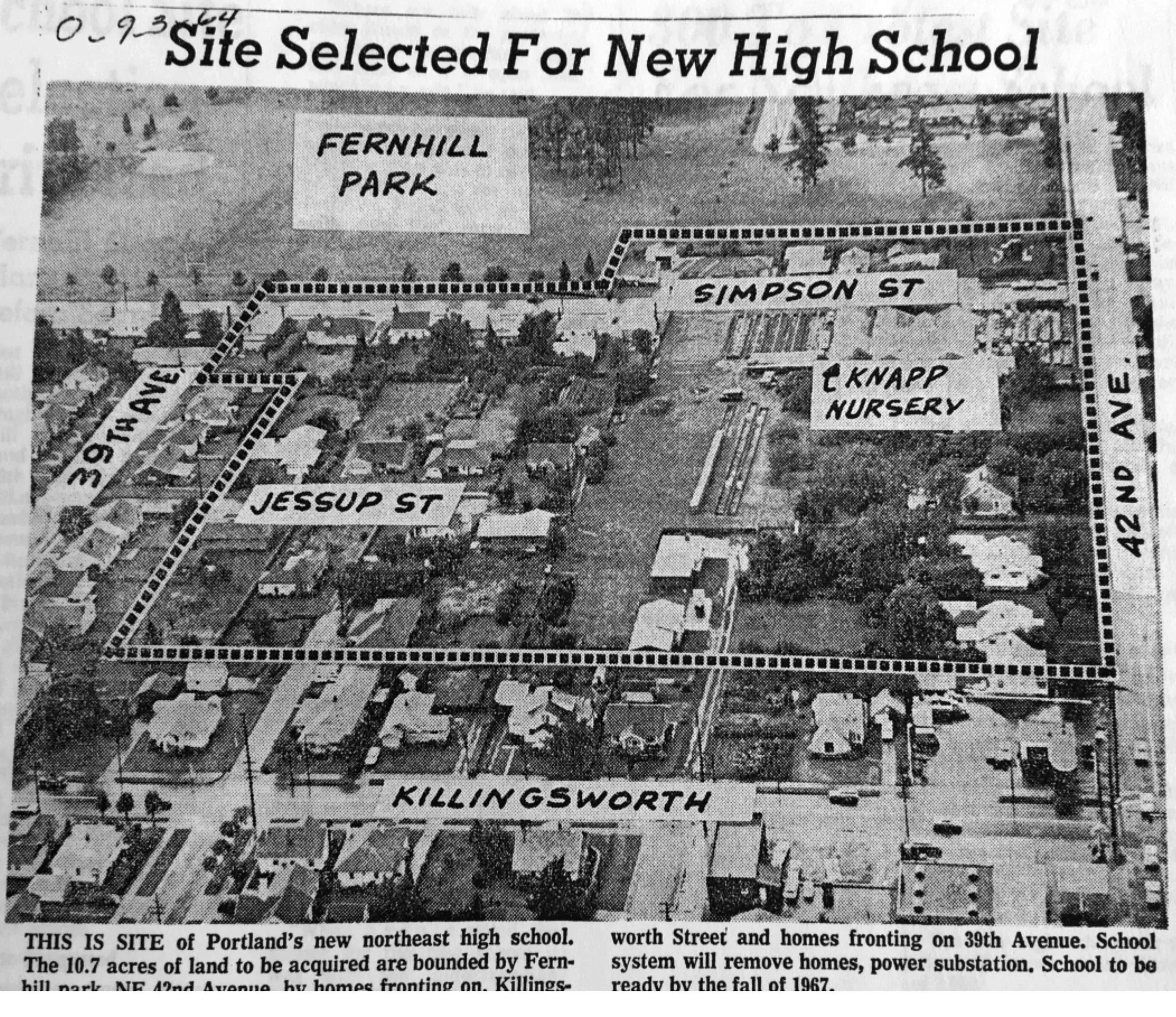
John Adams High School in Portland Oregon was a brand new school, part of the ‘Model Schools Project’ creating the schools of tomorrow.
Retrieved from: https://www.oregonencyclopedia.org/articles/adams_high_school/
In Portland, Oregon, John Adams High School was one of the schools to participated in the project. The school opened its doors in 1969, offering a transformed schooling experience. No longer would students travel between classrooms over six periods a day. Now they would gather for learning in different group sizes – lectures, classes, discussion groups. One third of a student’s time was left unscheduled so they could speak to teachers, work independently or relax, eat and socialise. The curriculum was reimagined too. Academic courses that had been managed by siloed departments was transformed into an interdisciplinary program taught by interdisciplinary teaching teams with a focus on societal challenges. Students were even engaged in participatory decision-making processes as teachers and administrators worked out the model.
In the early days, Adams High was praised widely as a model for what was possible in transformed schooling.
Initially, many students, especially the creative and autonomous ones, appreciated the flexibility. And, many of the teachers enjoyed the increased collaboration and the opportunity to teach differently in different class sizes, work with a reimagined curriculum and offer new electives.
But those students who had learnt how to learn in an environment where they were told what to do and when, were frustrated when teachers didn’t them what to learn or how. Those who had been previously disengaged with schooling fell through the cracks, often identified by teachers as having trouble using their time with efficiency. If a student was underachieving, parents blamed the flexible schedule.
And when the data was examined closely, some teachers were having fewer conferences with students than expected. And some, even in small discussion groups, continued to what they had always done: dominating the discussion, drawing on what they always knew about teaching.
Two months within opening, parents from the local community formed a group called “Citizens for a Better Adams”. Their complaints included: no respect was being explicitly taught, students didn’t understand authority, discipline, basic scholarship or orderly use of time. In the broader community, people were critical of students being given their own time, unsure how to reconcile the ideas of autonomy and discipline. There was an outcry about the erosion of academic standards.
Teachers, overloaded with having to replace old behaviours with new ones and the change in organisational patterns, began burning out. Parents and the community struggled to accept new patterns as the new normal, longing for what was familiar even though it had been less than optimal before. And so four years after it opened, the much lauded ‘model school of tomorrow’ reverted back to a traditional school model in 1972. Students went back to traditional classes, with traditional teacher supervision. The curriculum pulled back to offer fewer, mainstream choices. And in a signal of the reforms that would come in the next decade, the public and the administrators were in unequivocal agreement: students needed real schools, and as an industry, education needed to get back to the basics. The school eventually closed in 1981.
The invisible rules of schooling
On paper, the conditions for this kind of reimagining seemed perfect. In the background of all this, civil rights and feminist movements had been challenging the status quo. And in schools in America, students had been questioning the traditional norms of schooling, and teachers were working to individualise education, emphasising inquiry and social betterment so students could have more choice in schooling.
(Sound familiar?)
Backed by significant funding and research, the project was even led by a nationally recognised and celebrated secondary school reformer J. Lloyd Trump (no relation - don’t worry, I checked), who brought over 40 years of experience in education and leading transformational change.

We are biologically primed from an early age to learn the rules of language and grammar.
Photo by Stephen Andrews on Unsplash
So, what happened? And why are there so many stories like this?
Well, in order to answer that question, we need to first talk about grammar.
One of the wildest things I’ve learned about the acquisition of language and our initial understanding of grammar is that our brains are biologically primed to learn it. This means that as children, we’re not sat down with textbooks that talk us through tense, syntax and adjectives (that comes later). Our early understanding of what is grammatically correct and incorrect comes through interactions with our direct environment, and with the people in it.
The thing about grammar is that when you hear someone use it incorrectly, you don’t have to know the exact grammatical rule to know when it’s off. You just know it sounds wrong.
In their book Tinkering Toward Utopia, authors David Tyack and Larry Cuban propose that schooling has its own grammar. And this grammar, the grammar of schooling is so obvious that there’s almost no point in me pointing it out.
Let’s try this anyway. If I told you to close your eyes and picture ‘school’, what would you see?
Would it be a combination of the following?
Students grouped by age. Uniforms, with enforced dress codes. Learning divided into disciplines and in secondary school, taught in self-contained classrooms which are managed by one teacher who is responsible for the learning process, behaviour management and assigning grades for academic performance. In primary school, students stay with one teacher for a year, experiencing a holistic curriculum but seeing specialist teachers for specialist subjects. In secondary, the day is divided into periods with breaks for eating. There is a signal that indicates when students move between classes to experience subjects taught by a teacher who is considered an expert or specialist. Sometimes classes are grouped by ability level or standardised data. In senior schooling, students accumulate credits that contribute to a senior secondary qualification upon exit.
Did I miss anything?
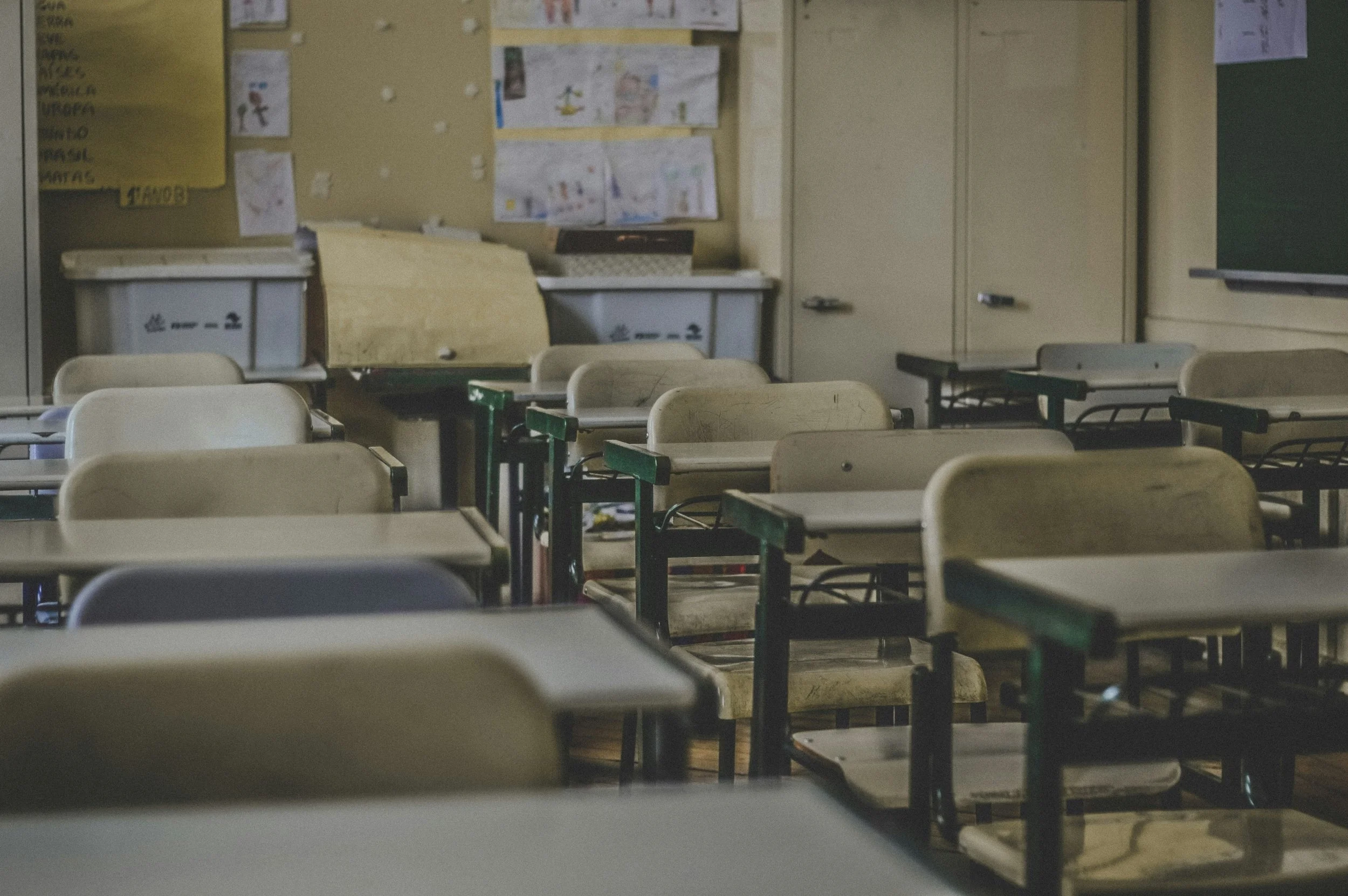
How schooling looks and works is shaped by an invisible system of rules that authors David Tyack and Larry Cuban call ‘the grammar of schooling’.
Photo by Feliphe Schiarolli on Unsplash
This is what the grammar of schooling looks like: the organisational and pedagogical forms of schooling that persist over time, despite efforts of many to change it. And this grammar, much like the way we learn to speak, is formed through our experience of education, and our interaction with educational environments. It is an invisible system of beliefs, values and accepted norms that are transferred and shared through relationships over generations. Our parents go through schooling; we go through it and some of us then become teachers and school leaders. Our politicians, and the people who have the power to allocate and spend money experience the same type of schooling. Over decades, we have internalised the idea that this is how schooling is done when it is done the right way.

Institutional isomorphism, a concept written about by Paul DiMaggio and Walter Powell, explain why so many organisations - and schools - end up looking like each other.
Photo by Robert Clark on Unsplash
This idea that there’s a legitimate type of school, or organisation is informed by what authors Paul Dimaggio and Walter Powell refer to as institutional isomorphism, a concept from the corporate world that explains why many organisations end up looking a lot like each other. Their theory is that organisations model themselves after similar organisations in their field that they perceive to be more legitimate or successful, even more so when there is social and political pressure, increasing uncertainty and competition in a commercial market. Any innovation or change, if adopted, only survives if it increases the legitimacy of an organisation. And in a world where schools compete for enrolments, funding and influence, institutional isomorphism also has a lot to do what kind of change sticks around in the long-term in schools.
Institutional isomorphism, along with the ‘grammar of schooling’, explains why, in a brand-new suburb, where a brand-new school is being built, we can generally predict the physical school building that will eventually exist – perhaps even what happens inside. And, it also explains why when something about schooling violates this grammar and these unspoken rules, then it’s not just that it feels off - it’s no longer credible or legitimate.
Let’s look at it like this. Consider that in your school, you make a change to those unspoken rules of about what makes schooling real and legitimate. You break the timetable, ditch the uniforms, change class sizes or start calling teachers by their first names. What happens next? Teachers complain. Parents push back. Student performance declines. Perhaps you even experience something akin to what happened in the Adams High story. Either way, changing the grammar touches a nerve, poking at the invisible system of beliefs that determine what we expect from schooling, and the part it plays in our lives. The responses can be raw, driven by fear, uncertainty and disbelief. As a parent once said to me: If you’re going to change that, you may as well say these kids live on a commune and all they do is sing kumbaya around a campfire all day. How do you think they’re going to get a job?
When you change the system, the system pushes back
The story of Adams High is consistent with a lot of the ways we do change and innovation in schooling. We spend a lot of time on the physical structures - the parts of school that we can see, point to and measure. But underneath our building and classroom designs, timetables, curriculum, extracurricular offerings and metrics, runs an invisible system that holds it all in place; a paradigm made up of hidden networks and structures that have been legitimised over decades of schooling. And if we want to think about where reimagining really happens, it’s here: in the invisible mental models, beliefs and norms we hold deeply but don’t stop to examine.

A change in the system that threatens the rules of the invisible system mobilises defenders to maintain the status quo.
Photo by Jason Leung on Unsplash
In the work of Coherence Co-Lab, we use the tools of systems thinking to surface these mental models before designing reimagined schooling structures. It can be an emotional and confronting process, but that’s to be expected. We are after all, as Brené Brown pointed out, feeling beings who think, not thinking beings who feel. And it’s worth pointing out that this work in the invisible system doesn’t stop stakeholders from bristling or pushing back. In fact Donella Meadows, one of the early writers in the field of systems thinking, said we should even expect it. When a change is made in a system that threatens the invisible rules, the system pushes back. Threatened, the system works to automatically mobilise and defend the status quo. It’s what happened at Adams High, and it what happens in so many schools I’ve worked with and have been a part of.
But the system pushing back, as Alexander Grashow, Marty Linsky, and Ronald Heifetz point out in The Practice of Adaptive Leadership, is a reminder that people don’t struggle with change just because it’s different. They struggle with the grief that comes with losing something that means something: an identity, a familiar structure, expertise, security, predictability, stability. How we make space for, and talk about, this grief matters if we truly want to reimagine schooling for a changing world that we have no reference for. This is why a Principal I knew who led a school that was considered an ‘alternative model’ but with 100% university entry told me that he spends weeks with prospective families talking through their mental models of schooling and expectations for success. And for prospective employees who would teach in the school in a reimagined model with different organisational patterns and cultural norms, the time spent in training (and de-conditioning, as he called it) was longer. And still, many returned to mainstream schools, yearning for the familiar grammar, even though they’d walked away from it in the first place.
The system pushing back is not the cue to stop and revert back to the way it’s always been done. It’s our cue to lean in and listen and continue to intervene with intelligence. This is system feedback to locate the right leverage points at the right level and above all, as Meadows puts it, to ‘dance’ with the system; to experiment and iterate with agility and sensitivity as the system responds to change.
This is how we break the pattern.

Donella Meadows likens systems change to a dance that requires us to lean in, listen to the beat, expose our mental models, stay humble and embrace complexity.
Photo by Ahmad Odeh on Unsplash
Reading & Research
Tinkering Toward Utopia by David Tyack and Larry Cuban
Adams High School from the Oregon Historical Society
What ever happened to…John Adams High School? by Richard R. Doremus
Whatever happened to J. Lloyd Trump? by Larry Cuban
The Iron Cage Revisited: Institutional Isomorphism and Collective Rationality in Organizational Fields by Paul J. DiMaggio and Walter W. Powell
The Practice of Adaptive Leadership by Alexander Grashow, Marty Linsky, and Ronald Heifetz
Systems Thinking: A Primer, Leverage Points: The best places to intervene in a system & Dancing with Systems by Donella Meadows from The Donella Meadows Project
The Dynamic Tension at the Core of the Grammar of Schooling by David Labaree
Early language and structural grammar acquisition comes from evolutionary educational psychologist, David Geary.