
Understanding the system to identify leverage for future impact
01 UniSQ
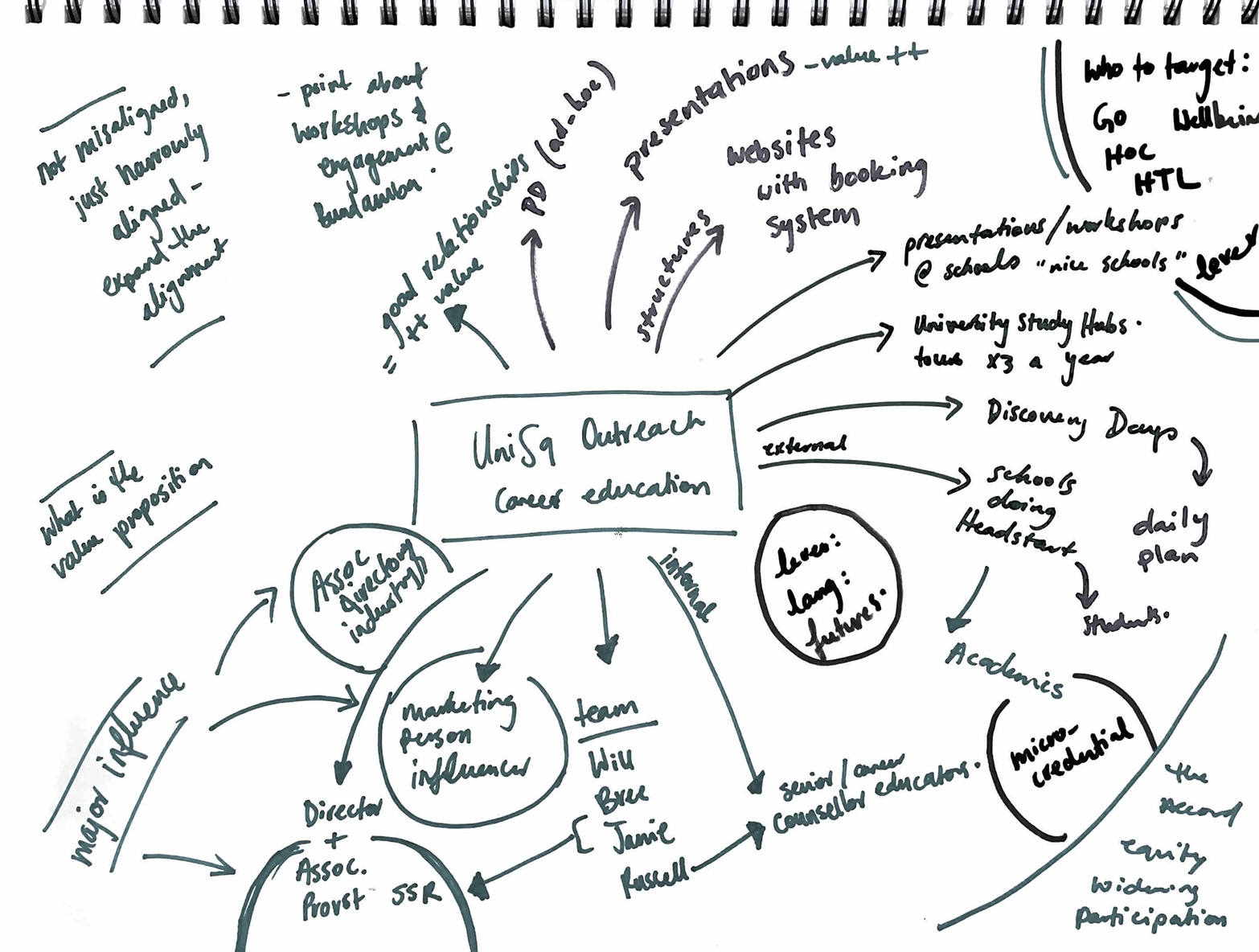
Systems mapping looks messy, but clarity comes through wading through the complexity.
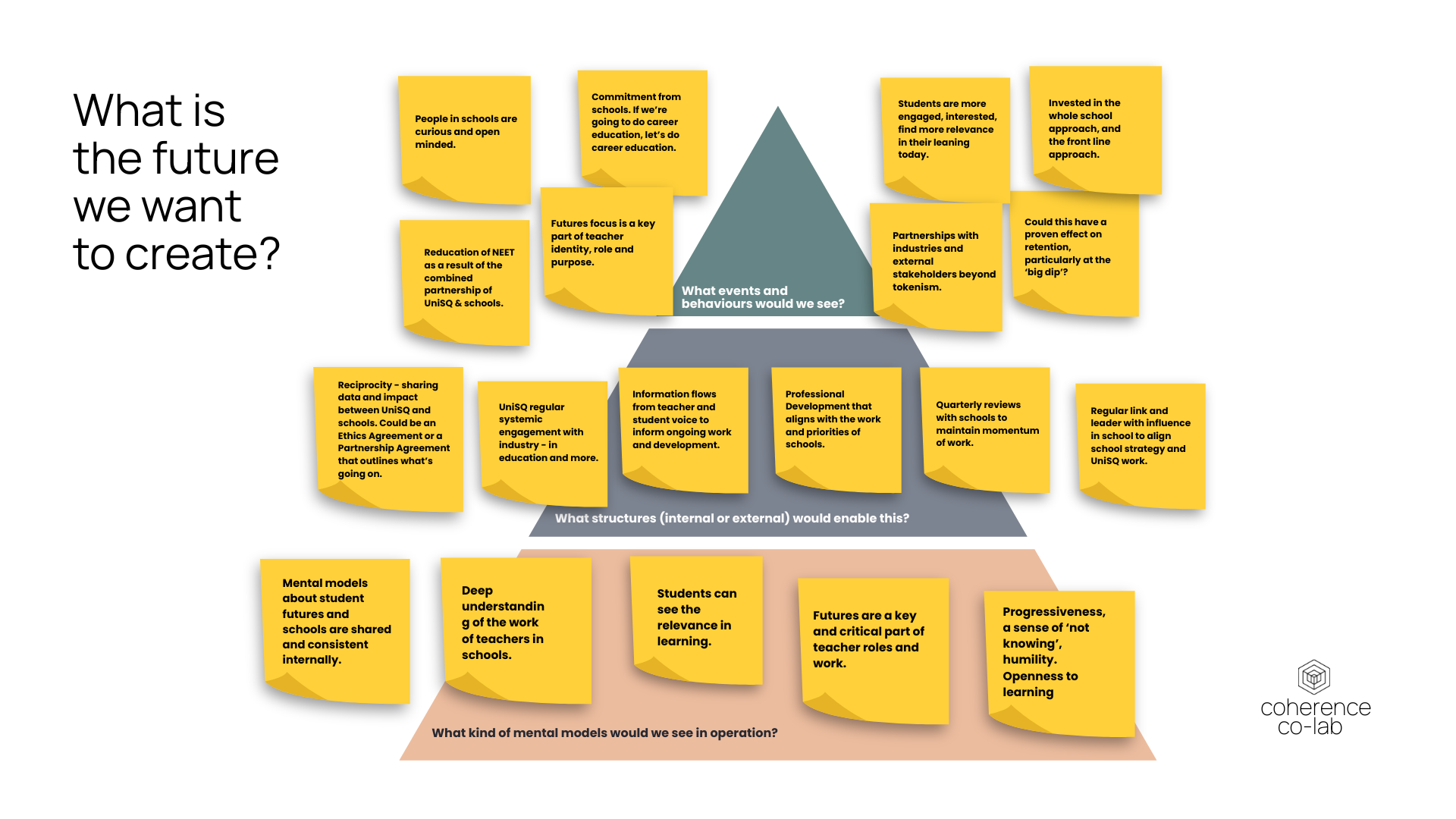
Creating your desired future isn't just about identifying ideal behaviours and events, it's also about identifying the paradigm shifts.
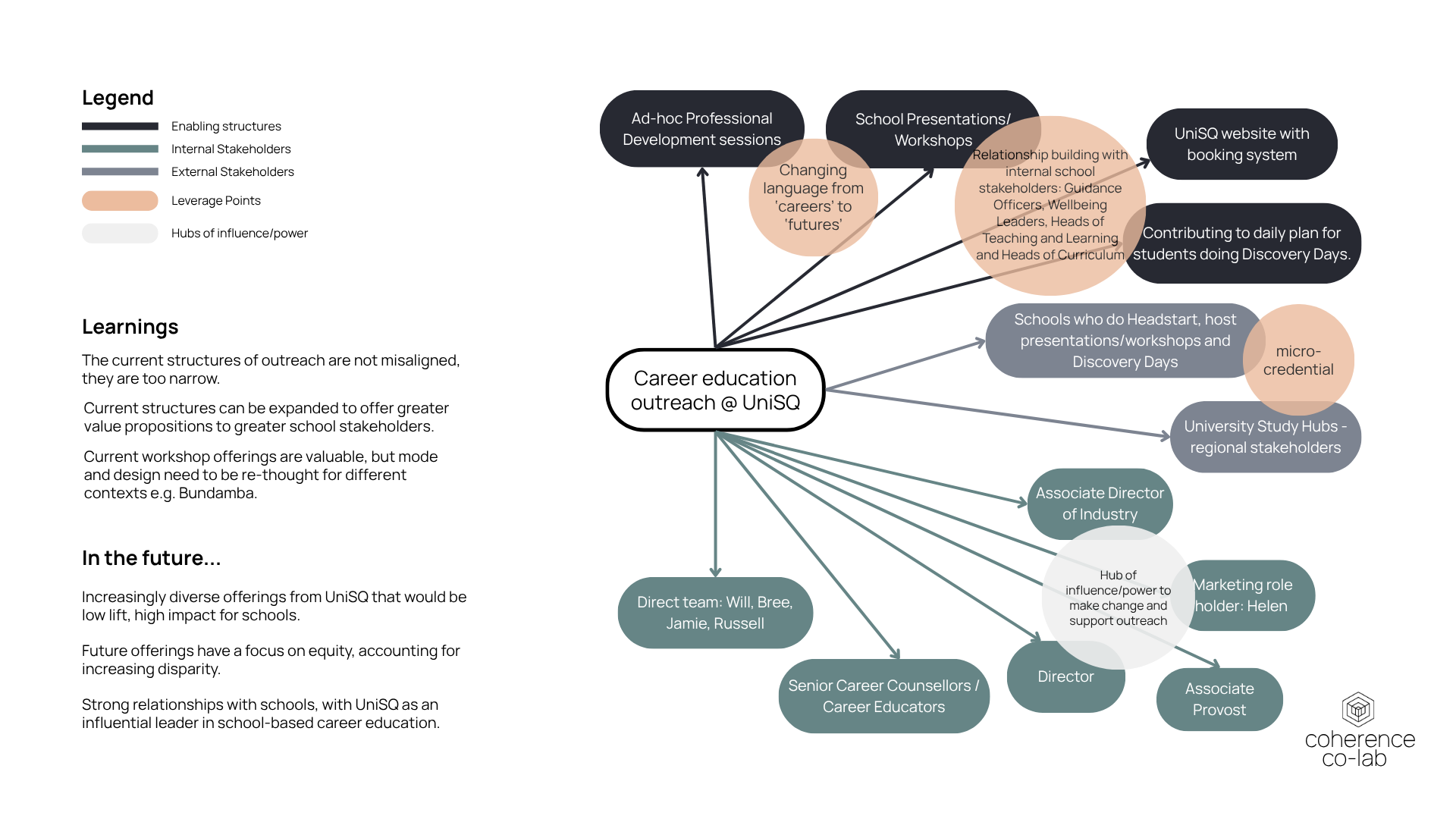
The final systems map shows stakeholder relationships, influences, leverage points.
Presenting Challenge
Many teams know the feeling of standing between a clear sense of where they want to go and a present that feels harder to read. The UniSQ Career Education team were in that space. They cared deeply about their work with schools and about the role career education can play in shaping how young people see their futures. They had ideas. They had momentum. They were ready to grow their impact.
But instead of accelerating forward, they chose something more deliberate. They paused and asked a different set of questions:
What is actually happening in the system around us?
What future are we trying to create?
Where does leverage for real change sit?
That decision shaped everything that followed.
Starting with the System
Our work began with the macro phase of the Coherence Co-Lab design loop. We weren’t looking for solutions, we were starting with perspective.
Together we mapped the ecosystem surrounding their work of the UniSQ Career Education team: schools, stakeholders, contributors, enabling conditions, and the relationships between them. We explored how the team currently operated within that system, what assumptions were guiding decisions, and where tensions were quietly shaping day-to-day choices. This kind of work is rarely neat or linear. When you start to see a system clearly, you are not just identifying structures. You are surfacing motivations, blind spots, strengths that have gone unnamed, and the subtle dynamics that influence what is possible. You are making things that are often taken for granted and invisible, visible. It can feel ambiguous and uncomfortable. It can feel like holding too many threads at once and it’s easy to feel overwhelmed. But this is where coherence begins to form.
The UniSQ team leaned into that process with openness and honesty. They stayed with the complexity long enough for patterns to emerge. Slowly, the leverage points for deeper impact became visible.
What Shifted
One of the most important shifts that occurred during this process was conceptual.
The conversation moved from:
What are we delivering?
to:
How do we position ourselves within the ecosystem to create impact?
This shift created new clarity about stakeholders, influence pathways, and opportunities that had previously been difficult to see. It also strengthened alignment within the team about their purpose and future direction.
As William Wragg, Manager of Career Education, reflected:
“In education, or work more broadly, we can get stuck on the ‘what’ — what are we going to teach or deliver, how should we design it. But it’s critical to take a step back and think about the ecosystem… the bigger picture… A moment when something clicked was when we started concentrating more on the broader ecosystem beyond the doing.”
He also described the experience of the process itself:
“Marian learns about you, your organisation, your goals, then helps to make your vision clearer, creating a clearer direction and roadmap towards success.”
The Outcome
This phase did not produce a finished program or initiative. Instead, it created something more foundational.
The team left with:
A clearer understanding of the system they were working within
Greater alignment around purpose and positioning
Identified leverage points for future development
A more intentional pathway forward
Beginnings like this reshape the possibilities and pace of what comes next. When you slow down enough to really see the system, movement becomes more deliberate, more coherent, and ultimately can have more impact.
What This Work Shows
This project illustrates how macro systems work can:
Reveal unseen leverage for impact
Strengthen strategic clarity
Align teams around shared purpose
Create stronger foundations for future design and innovation